

Poilievre wins Conservative leadership with commanding 68.1 per cent of the points on first ballot, pledges focus on pocketbook issues; party promises unity, downplays division

Seeking to rebuild a Conservative Party that has been relegated to the opposition benches in three straight federal elections, Pierre Poilievre convincingly won the Tory leadership race on Saturday night with a commanding 68.15 per cent of the points on the first ballot.
A member of the Conservative caucus since 2004, Poilievre (Carleton, Ont.) was the front-runner since he entered the field of five. He defeated fellow MPs Scott Aitchison (Parry Sound-Muskoka, Ont.) and Leslyn Lewis (Haldimand-Norfolk, Ont.), former Quebec premier Jean Charest, and former Ontario MPP Roman Baber. Charest finished second in the race with 16.07 per cent of the points. Lewis won 9.7 per cent, Baber won five per cent and Scott Aitchison won 1.1 per cent. Poilievre won 70.7 per cent of the total votes cast, Charest won 11.6 per cent, Lewis won 11.1 per cent, Baber won 5.4 per cent, and Aitchison won 1.2 per cent.
Poilievre won the endorsement of former prime minister Stephen Harper, as well as most of the Conservative caucus. According to the leadership vote results, Poilievre also won the leadership in 330 of the 338 ridings across the country, a landslide victory.
SPONSORED CONTENT

In his victory speech, Poilievre offered a hopeful message, focusing on affordability and promised to cut high taxes and get rid of “gatekeepers.”
“Tonight begins the journey of replacing an old government that costs you more and delivers you less with a new government that puts you first,” he told a packed crowd after being introduced by his wife, Anaida Poilievre, at Ottawa’s Shaw Centre in downtown.
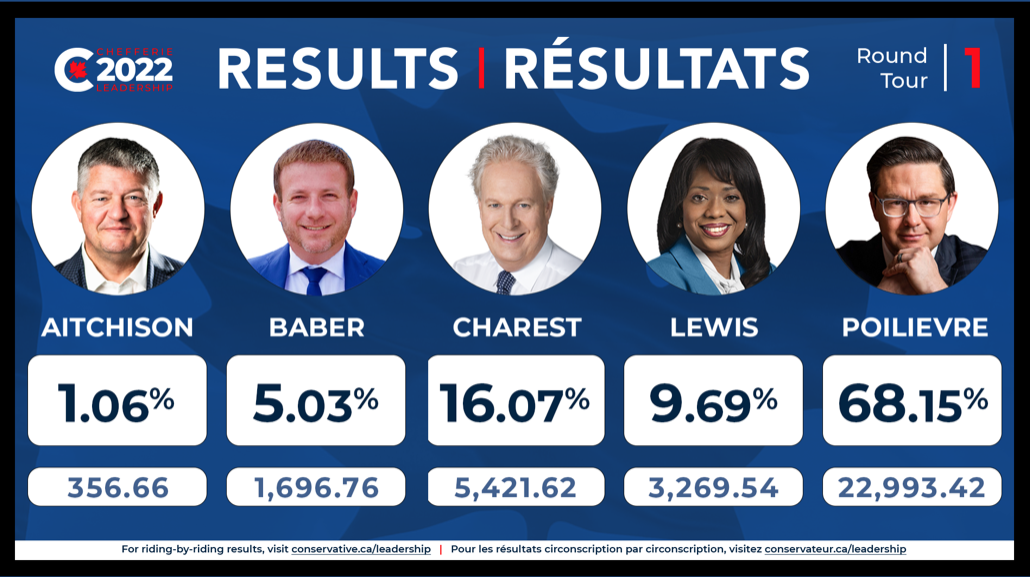
The Conservative Party’s leadership results released on the first ballot on Saturday night. Image courtesy of Conservative Party of Canada
During the leadership campaign, the former Harper-era cabinet minister put forward a social-media-savvy populist message attacking the federal government’s COVID restrictions and criticized the Bank of Canada’s monetary plans. The brash politician emerged as the favourite of the party’s right flank, but has also been criticized for supporting the Freedom Convoy.
Building on a campaign message attacking “identity politics,” he said Canadians need “hope” and not a government that “sneers at them” and “calls them names.”
“They don’t need a government to run their lives. They need a government to run a passport office,” he said in his victory speech, pitching himself as a prime minister who will “restore hope” for Canadians.
The loudest cheer of the night came when Poilievre called for ending the ArriveCAN and vaccine mandates.
“We must remove unequal barriers by axing the disastrous ArriveCAN app,” he said to roaring applause.
Poilievre also promised the Conservatives would make “government affordable so that life is affordable,” by capping spending, finding ways to reverse inflationary deficits, and “axing” new taxes on Canadians “paycheques, gas, heat and other essentials.
“We’ll fight climate change with new tech, not new taxes,” Poilievre said, adding that instead of printing more money, the government should be creating more things that cash can buy.
“Instead of doubling the money, we need to double the bread,” Poilievre added. “Let’s get rid of the government gatekeepers to build more homes, produce more food, and produce more energy right here in Canada.”

Pierre and Anaida Poilievre, pictured Sept. 10, 2022, are cheered after Poilievre won the Conservative Party’s leadership contest. The Hill Times photograph by Andrew Meade
Since the defeat of then-prime minister Stephen Harper in 2015, the Conservatives have gone through two leaders and two interim leaders, which have resulted in electoral defeats of the party led by Andrew Scheer in 2019 (Regina-Qu’Appelle, Sask.) and Erin O’Toole (Durham, Ont.) in 2021.
In the caucus, he only received the backing of a single Quebec MP—Pierre Paul-Hus (Charlesbourg-Haute-Saint-Charles, Que.)—while seven of the province’s MPs backed Charest.
Uniting the party will be one of Poilievre’s most important tasks in his early days as the fourth leader of the Conservative Party.
Conservative MP Joël Godin (Portneuf-Jacques-Cartier, Que.), who endorsed Charest, told The Hill Times in August that if Poilievre couldn’t pivot to the centre, he would think about leaving the Tory benches.
While Poilievre thanked all the candidates, he gave a special acknowledgement for Charest’s efforts during the 1995 Quebec referendum.
Conservative House Leader MP John Brassard (Barrie-Innisfil, Ont.), meanwhile, told The Hill Times before Poilievre was elected on Saturday night, that he isn’t concerned about party unity and said it wasn’t as major of a problem as some may believe.
“When the parliamentary session ended in June, our caucus was united and we were singularly focused,” Brassard said.
Brassard said that any time the country has faced issues of “great magnitude” like inflation and affordability, or “any of the other issues we’re facing domestically and internationally,” an expression of differing ideas to find solutions to those problems was important, and that the leadership campaign was no different.
Brassard said that the party and the new leader would begin to work on those issues and their solutions almost immediately.
“I think we’ll hear a message of unity, but not just within our caucus, but the need to unify the nation as well,” Brassard said. “The nation right now is so divided and we need to provide an alternative to the Liberals. A message of hope and opportunity.”

Pierre Poilievre, pictured Sept. 10 at the Shaw Centre, received the loudest applause of the evening when calling for the end of the ArriveCAN app. The Hill Times photograph by Andrew Meade
In a video message, O’Toole joined the call for unity.
“To my Conservative friends, remember, where there is unity, there is always victory. So let’s show Canadians a united, strong, and compassionate Conservative party,” he said.
Conservative MP Marilyn Gladu (Sarnia-Lambton, Ont.) told The Hill Times before Poilievre was elected on Saturday night that, despite the divisiveness of the leadership campaign and some of the rhetoric between each party’s camp, she didn’t believe it was any more contentious than any other leadership race and that once a new leader was chosen, the party would begin to come together.
“We’ve always had a big-tent party and it’s time to get back to that,” Gladu said. “Trudeau is certainly pre-positioning that he may call one early and Jagmeet Singh has indicated that if he doesn’t get his Christmas wish list, there could be a problem.”
Gladu also praised now former-interim leader Candice Bergen for the “amazing job” she did keeping the party “unified and positive.”
The mood inside the main hall of the Shaw Centre remained relatively sombre prior to the announcement—the room was bathed under Tory blue mood lighting while a saxophone and violin duo played God Save The Queen and Amazing Grace from the stage as attendants began to take their seats, but the atmosphere in the reception just outside the hall remained quite high. With the sun still high over the Parliament Buildings and shining through the Shaw Centre’s glass dome structure, Conservative party members, MPs, Senators’ staff, and political strategists mingled by the cash-bar.
Back inside the main hall, tributes to Queen Elizabeth II, who died on Sept. 8 at the age of 96 and after reigning for 70 years, continued throughout the night, including by the new leader and former interim leader.
“Two tiny words: the Queen. Yet on every continent those two words conjure more than a picture. They also express an idea—the idea of decency and duty,” Poilievre said. “She exhibited the virtues we most cherish: dignity, civility, humility, candour, and above all else, service. That’s why her death—though not expected—is nonetheless shocking.”
Bergen said that she was saddened by the death of “our Queen,” who she said served with honour and whose place in the story of Canada would be one as great as that of Queen Victoria.
“We should all strive to emulate the dignity and grace that she personified throughout her reign,” Bergen added.
Bergen continued by thanking the “literally hundreds of thousands” of Canadians who had joined the party and whose optimism and excitement confirmed to her and the Conservative caucus that they were on the “right track.”
“My heart is truly filled with gratitude,” Bergen said.
In a final message to her party’s caucus as interim leader, Bergen also called on party members to not allow themselves “whatever kind of Conservative you are, to be broken into groups and labelled.”
“Do not descend into the culture of identity politics and division in our party,” Bergen urged. “Even when you disagree with each other, actually, especially when you disagree with each other.”
“I have no doubt we will support our new leader, buttress the new team, advise them, and give our new leader the chance to flourish and pave the way for a new federal Conservative government,” she said.

Conservative leadership candidate Jean Charest, right, and his wife Michèle Dion, pictured Saturday night after the results were announced. Charest finished second with 16.07 per cent of the vote. The Hill Times photograph by Andrew Meade
Despite a contentious campaign that created speculation the party may fracture, the Conservative party has quadrupled in memberships since the end of 2021, with 678,702 members eligible to vote as of June 3, 2022, and more than membership totals of the previous two leadership elections–in 2020 and 2017–combined.
At the end of last year, the party membership stood at 169,705. And in the 2020 leadership election, the party had 261,984 members, up from 250,958 members in 2017.
The Conservatives saw the largest growth in their membership, by percentage, in Newfoundland and Labrador, British Columbia, New Brunswick, and Quebec which saw the greatest proportional growth of over 750 per cent.
Of those new members, the Poilievre campaign claimed to have signed up more than 311,000. While the remaining candidates had not released exact numbers, Charest said he had signed up tens of thousands and the since-disqualified campaign of former mayor of Brampton, Ont., Patrick Brown, said it signed up more than 150,000.
Get Today’s Headlines Newsletter
Your quick scan of the news you need each weekday to be the smartest person in the room.
By entering your email address you consent to receive email from The Hill Times containing news, analysis, updates and offers. You may unsubscribe at any time. See our privacy policy
Eligible party members had until 5 p.m. on Sept. 6, to return their completed ballot packages to the election campaign’s official vote receiver and auditor Deloitte, either by mail-in ballot or in person drop-off.
According to a press release from the Conservative Party on Sept. 8, 437,854 ballots had been returned by the deadline and that 417,987 votes had been accepted. The validated ballots would remain sealed and tagged by riding association and fed into the vote counting machine to be tabulated on election night.
The remaining 19,867 votes that had been rejected, according to the party press release, were most commonly found to be invalid due to missing voter identification, followed by missing signed attestations.
Editor’s note: This story has been corrected to clarify that Pierre Poilievre won 68.15 per cent of the total points, not of the total vote. He won 70.7 per cent of the total votes cast (417,987). He also won 330 of the 338 ridings.
nmoss@hilltimes.com
sbenson@hilltimes.com
The Hill Times


