NAC’s Resident Chef program gives Indigenous cuisine a national stage
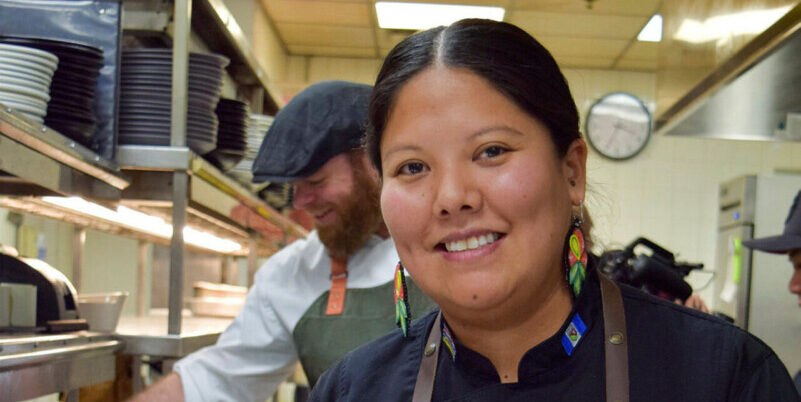
There aren’t many restaurants where Steph Baryluk comes from, which is part of why becoming a chef still feels a little ironic to her.
Now, her food is at the centre of the menu at one of Ottawa’s most prominent cultural institutions.
As the National Arts Centre’s current resident chef, since March, Baryluk has been bringing Indigenous-inspired cuisine from the Arctic to 1Elgin. Her time as resident chef will end at the beginning of June.
SPONSORED CONTENT

First launched in 2019, the NAC’s Resident Chef program brings in a new—and often emerging—chef every few months, giving them the chance to build a menu and cook for a national audience.
But for Baryluk and the other Indigenous chefs who have come through the program, the residency is doing more than offering diners something new. It is also creating space for Indigenous chefs to talk about where they come from, what their food carries, and why that work matters at a time when Indigenous cuisine remains underrepresented in Canada’s public dining spaces.
“Indigenous cuisine is extremely underrepresented,” said Baryluk, who is from Teetl’it Zheh (Fort McPherson) in Treaty 11 territory.
For her, that underrepresentation is tied in part to the fact Indigenous food is often flattened into a single category.
“There are many Indigenous nations throughout the country,” she said. “They all have different traditions, different stories, different foods that they eat.”
That distinction shapes the way Baryluk approaches her residency. Growing up in a remote northern community, she said food was never separate from the land or from the work required to get it.

“Everything is gathered, everything is harvested,” she said.
“To see the process of everything being broken down, how are things cooked, how are things preserved, how do we hunt in different parts of the year, how do we gather in different parts of the year. So it was just this really rich upbringing that kind of shaped my way into food.”
Bringing that relationship into a public restaurant is not always simple. Baryluk said Indigenous chefs often have to work within sourcing limits, regulations, and the realities of an institutional kitchen.
“One of the first questions we need to ask and we need to get through is, ‘what can we source?’”
That means the menus she builds are not a strict rendering of one place so much as a reflection of her full journey as a chef—her training, her travels, and her effort to introduce Indigenous cuisine to people who may be trying it for the first time.
“The way I go about developing menus and recipes is actually my whole journey as a chef,” Baryluk said. “People who are sitting down at that restaurant may have never tried any Indigenous cuisine before. So this is kind of an introduction to it.”
Baryluk said that introduction matters for reasons beyond exposure.
“It’s one thing to talk about reconciliation, but it’s another thing to actually do it,” she said.
“By cooking our food, by sharing our stories and our photos, you know, that’s reconciliation.”
Food can be educational, not just artistic, says chef Commandant
Chris Commandant, a Kanien’kehá:ka chef from the Wahta Mohawks First Nations community and a former resident chef at 1Elgin, said the program did more than just help move his career forward—it gave Indigenous chefs a rare kind of visibility.
Commandant, who was selected as a resident chef in 2024 and now serves as sous-chef at 1Elgin, said the opportunity “opened a lot of doors,” but what stands out to him most is what the program represents for Indigenous chefs coming up now.
“It’s providing a voice to our generation, up-and-coming generation, as well,” he said.
He described the residency as one of the first programs of its kind to give Indigenous chefs a real stage inside a major cultural institution not only to cook, but also to speak about the place Indigenous food holds in Canadian culture.

“It’s lending itself to being the first program of its kind to provide an Indigenous community, or members from its communities, with a real stage and a voice for it,” he said.
“We have Indigenous theatre here [at the NAC], and it allows Indigenous artistry to thrive and to grow. This is the first time I have seen an iteration where it is encouraged from non-Indigenous members of communities to have a focus on that indigeneity and its importance and its role in Canadian cuisine.”
Commandant said that matters in part because Indigenous cuisine is too often grouped together rather than understood as a collection of distinct food traditions, each tied to different nations, territories, and histories.
“Everybody kind of categorizes Indigenous food under one umbrella,” he said. “But there’s so many unique voices that exist within the country.”
That, he said, is where the program’s educational value becomes especially important. Commandant connected that work directly to truth and reconciliation, arguing that education does not only happen in a classroom.
“And that’s one of the true calls [of the Truth and Reconciliation Commission],” he said. “Education can be interpreted in many different ways. The forum to speak, to present, to create, can also be informative for people. It can be an educational piece, not just artistic.”
When chefs speak about their ingredients, where they come from, and the lived experience behind them, they are also teaching people things they may not encounter otherwise, Commandant said.
“When our chefs are up there and they’re speaking to their lived experience and presenting their ingredients, they’re educating people with things that they may have never seen and may never see again,” he said.
“Programs like this are extremely important to the longevity of the Indigenous voice [and] the Indigenous culinary scene.”
Nelson Borges, 1Elgin’s program manager, said that broader educational and artistic role was part of the thinking behind the Resident Chef program’s launch.
Get Today’s Headlines Newsletter
Your quick scan of the news you need each weekday to be the smartest person in the room.
By entering your email address you consent to receive email from The Hill Times containing news, analysis, updates and offers. You may unsubscribe at any time. See our privacy policy
Borges said the NAC sees chefs as artists, too, and the restaurant as another place where storytelling can happen.
“The program really brings Canada to Ottawa, and it gives those emerging culinary artists an opportunity to be on a national stage,” he said.
Borges said that matters not only because it helps chefs grow in their careers, but also because it gives audiences another way to encounter Indigenous expression inside a national institution.
“It’s important that we provide that venue for people to come and experience what Indigenous [culture] really is,” he said, “from a culinary aspect.”
Borges said the program began with regional research and targeted outreach, but as it has grown, chefs now also reach out directly, giving the NAC a wider pool to choose from. So far, since its launch, nine Indigenous chefs have taken part in the program.
sharb@hilltimes.com
The Hill Times