
A needle-free way to protect against COVID
Sponsored Content By McMaster University

 Targeting variants of concern
“A year and a half ago, when we designed this vaccine, we were thinking about the future,” says Brian Lichty, an associate professor in the Department of Medicine who co-led the preclinical study. “We knew COVID would evolve and that there could be variants. We didn’t want to follow the strategy of making a variety of vaccines that chase the latest variant. We designed our vaccine to anticipate those changes.”
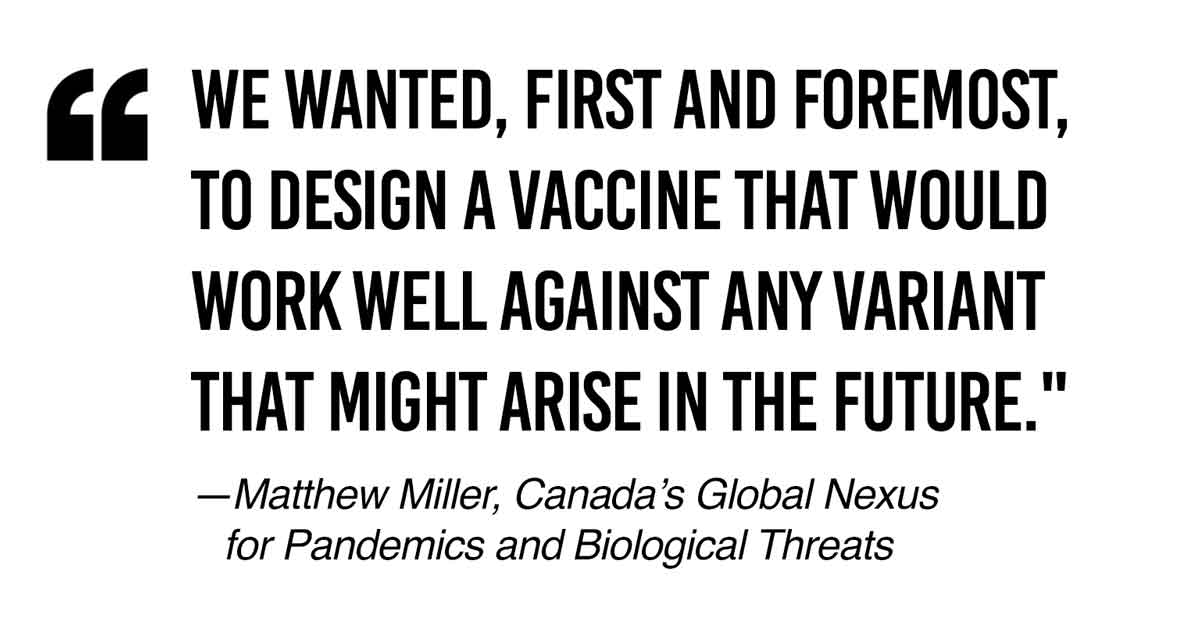
Rather than targeting only the spike protein — the part of the virus that mutates most rapidly and allows it to hide from our immune system — the new vaccine targets three parts of the virus, in particular, components that the virus has a very hard time mutating, explains Matthew Miller, an associate professor at McMaster’s Michael G. DeGroote Institute for Infectious Disease Research.
“We can remain ahead of the virus with our vaccine strategy,” says Miller. “Current vaccines are limited because they will need to be updated and will always be chasing the virus.”
Targeting variants of concern
“A year and a half ago, when we designed this vaccine, we were thinking about the future,” says Brian Lichty, an associate professor in the Department of Medicine who co-led the preclinical study. “We knew COVID would evolve and that there could be variants. We didn’t want to follow the strategy of making a variety of vaccines that chase the latest variant. We designed our vaccine to anticipate those changes.”
Rather than targeting only the spike protein — the part of the virus that mutates most rapidly and allows it to hide from our immune system — the new vaccine targets three parts of the virus, in particular, components that the virus has a very hard time mutating, explains Matthew Miller, an associate professor at McMaster’s Michael G. DeGroote Institute for Infectious Disease Research.
“We can remain ahead of the virus with our vaccine strategy,” says Miller. “Current vaccines are limited because they will need to be updated and will always be chasing the virus.”
 Protection against other pandemics
McMaster’s aerosol COVID vaccine strategy was built on the foundation of decades of robust tuberculosis vaccine research established by study co-author Zhou Xing from the McMaster Immunology Research Centre.
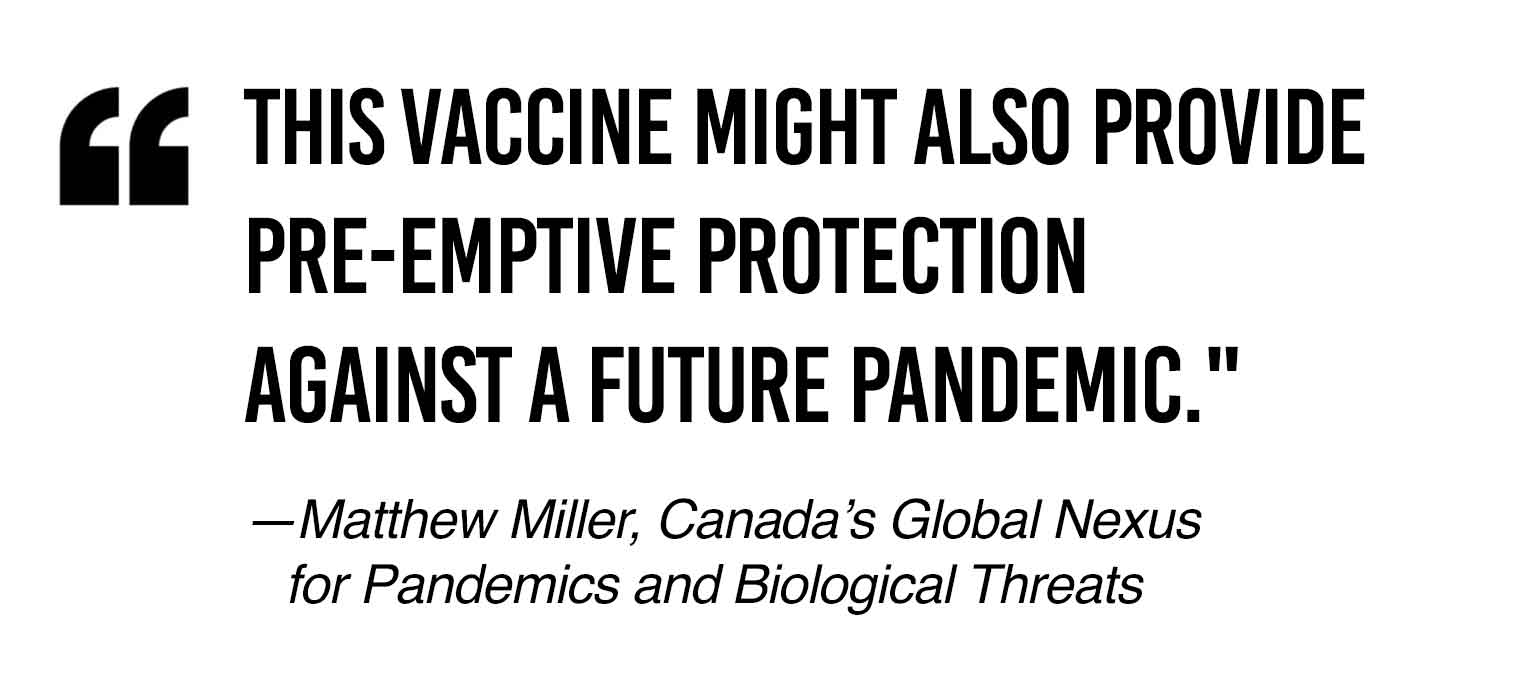
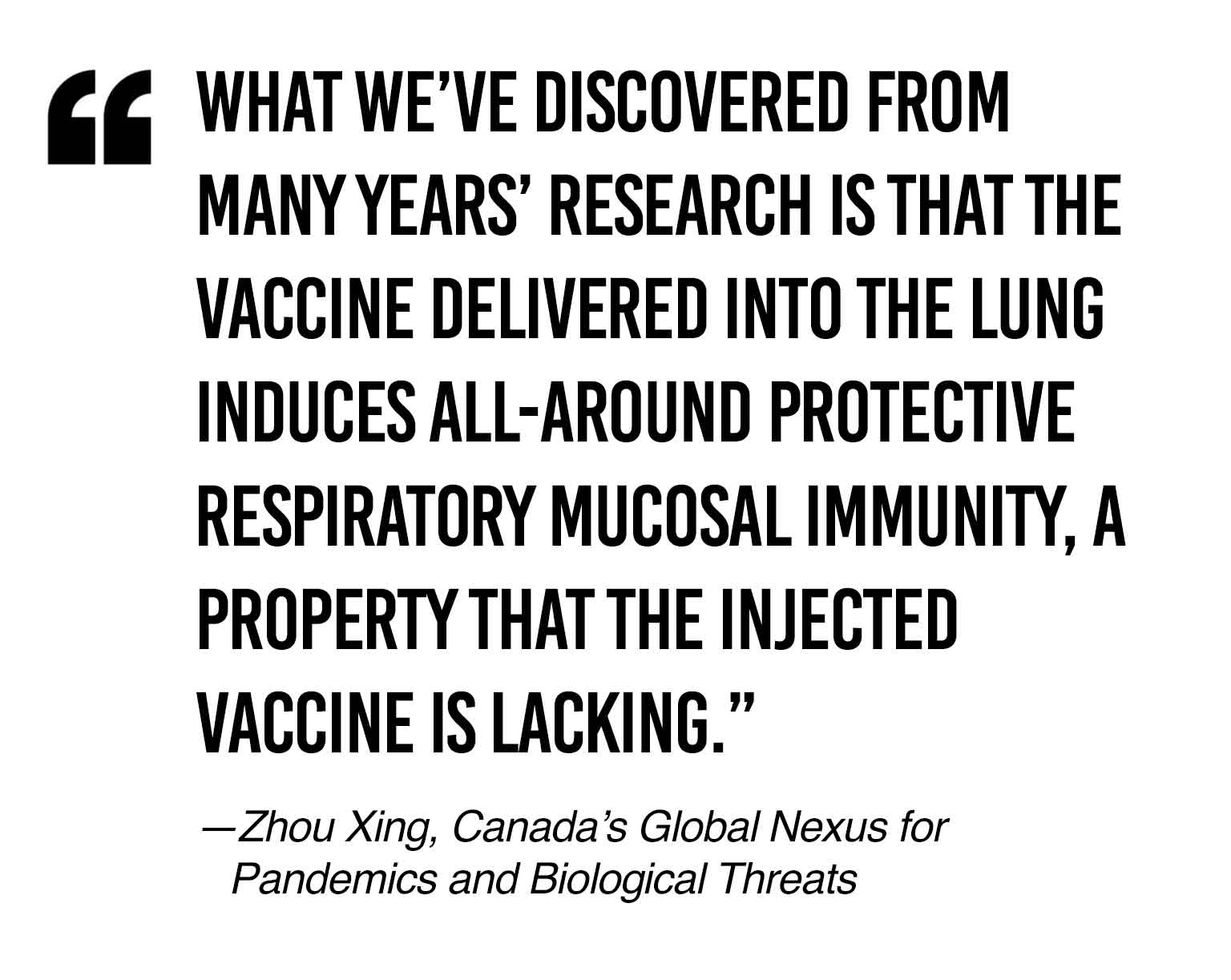
The new vaccine not only goes directly to the lungs, it puts the immune system on high alert for other respiratory threats and pathogens that target the lungs. The powerful immune response prepares the lungs to deal with a range of potential infections.
Protection against other pandemics
McMaster’s aerosol COVID vaccine strategy was built on the foundation of decades of robust tuberculosis vaccine research established by study co-author Zhou Xing from the McMaster Immunology Research Centre.
The new vaccine not only goes directly to the lungs, it puts the immune system on high alert for other respiratory threats and pathogens that target the lungs. The powerful immune response prepares the lungs to deal with a range of potential infections.
 The vaccines were produced at McMaster’s Robert E. Fitzhenry Vector Laboratory, one of a very few facilities in Canada with the capacity to develop and produce viral vector vaccines for clinical trials. The laboratory and the researchers are part of McMaster’s Global Nexus for Pandemics and Biological Threats.
These innovations are among the many ways in which McMaster experts at Canada’s Global Nexus for Pandemics and Biological Threats are protecting our communities and preventing the next pandemic.
The vaccines were produced at McMaster’s Robert E. Fitzhenry Vector Laboratory, one of a very few facilities in Canada with the capacity to develop and produce viral vector vaccines for clinical trials. The laboratory and the researchers are part of McMaster’s Global Nexus for Pandemics and Biological Threats.
These innovations are among the many ways in which McMaster experts at Canada’s Global Nexus for Pandemics and Biological Threats are protecting our communities and preventing the next pandemic.

 © 2026 Hill Times Publishing